


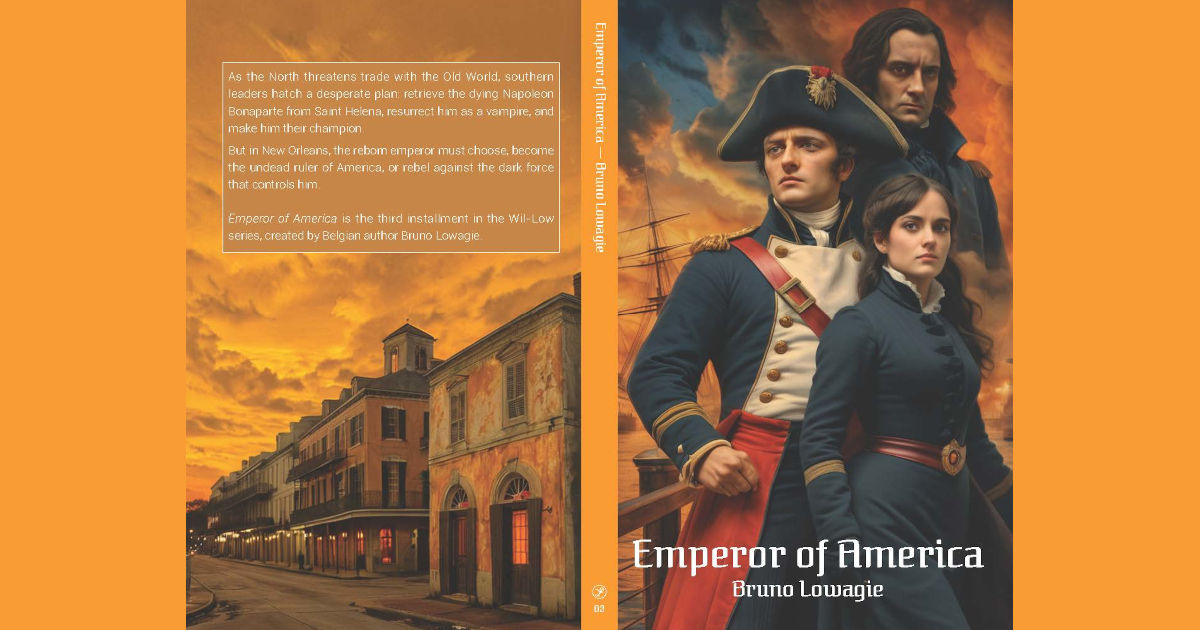
Wil-Low Series #3: Emperor of America
ISBN: 9798187842162
Release date: October 1, 2026
Available on Amazon
Every empire is built on something that feeds.
Story: 92 pages
End notes: 40 pages
Total page count: 136 pages
Blurb: As the North threatens trade with the Old World, southern leaders hatch a desperate plan: retrieve the dying Napoleon Bonaparte from Saint Helena, resurrect him as a vampire, and make him their champion. But in New Orleans, the reborn emperor must choose—become the undead ruler of America, or rebel against the dark force that controls him.
Screenplay
A password-protected screenplay version (third-draft version) is available on FilmFreeway.
The screenplay was submitted to Final Draft's Big Break Screenwriting Contest 2026 and was selected as a Quarter Finalist (August 28, 2026).
Excerpt from the Reader Feedback (June 2026):
The script is working with a really interesting, compelling premise, and it really utilizes the era and the characters in a way that leaves no stone unturned. It does a good job of explaining why Haiti would be such a valued location for America, and why Napoleon would be such a key asset for this. The script also finds a lot of surprising conflict and dynamics in the details – like Lowe and Blue arguing over a truce between the humans and the “inhuman” entities like the vampire rats. Seeing a historical figure like Napoleon clash with such a larger-than-life concept like vampires is loaded with potential, and the script really maximizes the number of ways this concept can be explored. Napoleon is really well-written, and even though the script is fictional, he feels like an authentic portrayal of the real person. His talk with Vignali on his death bed is fantastic, and the following conversation with Lunédi is epic. They both have strong wills, and the scene plays with this in a fantastic way. It's easy to understand his motivation for joining them, and his later motivation for turning against them. His decisions are often ruthless and strategic, making him feel like he’s earned the reputation that he has. Lunédi is also a great villain, who commands the scenes he’s in. He carries a great deal of menace and power in the way he talks/behaves, which is evident in the way he shows up unannounced to the plantation meeting in Act 1. He’s terrifying but often necessary (from the perspective of the people he controls) which really makes him feel like a force to be reckoned with – which he sums up nicely when telling Napoleon that he’s the one who comes when death is “negotiable.”
Table of Contents
- Prologue ... 5
- Chapter 1: We Need a Leader ... 10
- Chapter 2: Emperor in Exile ... 16
- Chapter 3: James Fort Falss ... 19
- Chapter 4: The Dying Emperor ... 24
- Chapter 5: Scrutiny ... 29
- Chapter 6: Ashes ... 32
- Chapter 7: Hunger ... 36
- Chapter 8: Blood ... 39
- Chapter 9: Opening Shots ... 42
- Chapter 10: The Puppet President ... 45
- Chapter 11: Mission Accomplished ... 48
- Chapter 12: Resurrection ... 51
- Chapter 13: Obedience ... 55
- Chapter 14: Joséphine ... 58
- Chapter 15: Illusion ... 62
- Chapter 16: Escape ... 65
- Chapter 17: The Bond ... 69
- Chapter 18: The Price ... 73
- Chapter 19: Black Wings ... 76
- Chapter 20: The Cost ... 79
- Chapter 21: The Turning Tide ... 81
- Chapter 22: The Fall ... 85
- Chapter 23: Mercy ... 88
- Chapter 24: What Remains ... 91
- Epilogue ... 94
- Background Information ... 97
Book Fragments
Do you want to know what to expect from this book?
Check out these fragments:
- Fragment 1: The full chapter 4 in which Napoleon is turned into a vampire by Baron Lunédi.
- Fragment 2: Some words about the author, the genre, and what inspired the author to write the story.
- Fragment 3: Some of the end notes for chapter 4.
Visit the home page to learn more about the other titles.
Videos
End Notes: Illustrations


.jpg)
.jpg)


_Portrait.jpg)

.jpg)

.svg)


,_RP-P-1904-1391.jpg)
;_Cyrus_(1813);_Medina_(1813);_Carron_(1813);_Cyrene_(1814);_Falmouth_(1814);_Hind_(1814);_Slaney_(1813);_Lee_(1814);_Spey_(1814);_Esk_(1813);_Leven_(1813);_Erne_(1813);_Larne_(1814);_Tay_(1813);_Bann_(1814)_J4372.jpg)


,_château_de_Malmaison,_cage_d%27escalier_2.jpg)
,_château_de_Malmaison,_cage_d%27escalier_1.jpg)


Series
Topics